Children's Education: Experimenting with Constructivism – Learning from Experiences and Self-Evaluation
In the realm of education, a revolutionary approach is gaining traction - Constructivist learning. This method, first proposed by Swiss psychologist Jean Piaget, posits that children are active participants in making sense of the world around them.
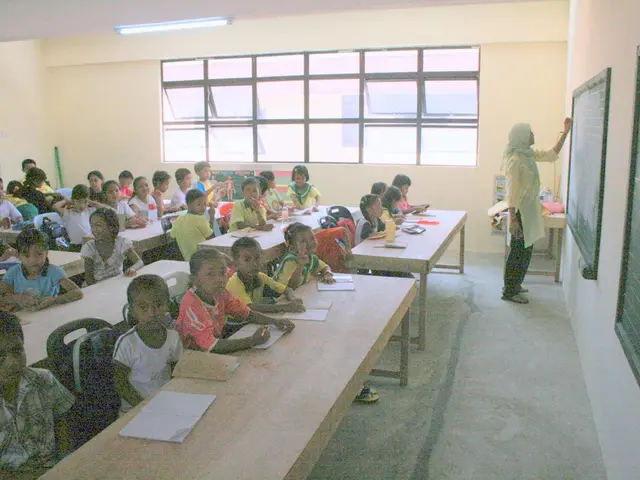
At the heart of constructivist learning in early childhood education lies active learning and exploration. Children are encouraged to engage with their environment, whether through sensory activities, hands-on experiments, or play-based learning. This approach fosters cognitive development, promoting problem-solving, critical thinking, and creativity.
Social interaction and collaboration are also vital components of this method. Learning is a social process, and children engage with peers and teachers to share ideas, challenge assumptions, and build collective understanding. This aligns with the social constructivism theory proposed by Russian psychologist Lev Vygotsky.
Reflecting on experiences is another key aspect of constructivist learning. Children are encouraged to reflect on their actions and outcomes, which helps them deepen their understanding. This process of reflection encourages personalized learning experiences that cater to each child's interests and abilities.
Differentiated instruction is also a hallmark of constructivist learning. Teachers tailor their teaching methods to meet the unique needs and learning styles of each child, creating an inclusive learning environment.
Constructivist learning environments, such as the Museo dei Bambini, offer exhibits designed to allow children to form hypotheses, observe outcomes, and revise their thinking. For instance, the Chaos Wheel helps children learn about systems thinking and complexity science by demonstrating that even tiny changes can have significant effects. Another exhibit, Spin to Life, lets children control a circular ecosystem, teaching them about interconnected systems and the ripple effects of change.
Research supports the benefits of constructivist learning. A study published in Cognitive Science in 2015 found that children develop stronger problem-solving skills when allowed to experiment and learn from their mistakes. The self-explanation principle, as highlighted by a 2009 review by Wylie and Chi from Arizona State University, suggests that encouraging children to articulate their reasoning during tasks enhances their understanding of the material.
Families can support constructivist learning at home by embracing open-ended questions, celebrating mistakes, and providing materials that encourage exploration. By fostering an environment that values active learning, reflection, and experimentation, we can help children develop the lifelong tools necessary for success, such as how to approach a problem, test an idea, revise a plan, and try again.
In conclusion, constructivist learning in early childhood education provides a holistic approach to learning that integrates cognitive, social, and emotional development through active engagement and reflection. By embracing this method, we can empower children to construct their own understanding of the world, fostering a love for learning that lasts a lifetime.
Children at the Museo dei Bambini engage in education-and-self-development through hands-on exhibits that promote lifelong-learning and learning by doing, in line with the Constructivist learning approach. This method encourages active learning and reflection, aligning with the social constructivism theory, thereby fostering problem-solving, critical thinking, and creativity in bambini.